|
|
Poet who was one of the most important figures in 20th century Turkish literature and one of the first Turkish poets to use more or less free verse. Hikmet became during his life time the best-known Turkish poet in the West, and his works were translated into several languages. In his home country Hikmet was condemned for his commitment to Marxism and remained decades after his death a controversial figure.
Hikmet was born in Salonica, Ottoman Empire (now Thessaloniki), where he briefly attended the Naval War School, but dropped because of ill healt. During the war of independence he went to Anatolia to join Atatürk and worked then as a teacher at a school in Bolu. He studied then sociology and economocs at the University of Moskow (1921-28) and joined Turkish Communist Party in the 1920s.
On his return to Turkey in 1928 Hikmet wrote articles for newspapers and periodicals, film scripts and plays. Because of his unauthorized reentry into Turkey he was sentenced to a prison term but pardoned in 1935 in a general amnesty.
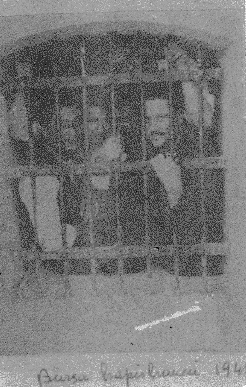
In 1938 Hikmet was condemned to prison for 28 years and four months for anti-Nazi and anti-Franco activities. Hikmet was released in 1950 because of international protests and left his home country due to fear of an attempt on his life
After losing his Turkish citizenship Hikmet became a Polish citizen. Broken in heath Hikmet lived from 1951 his remaining days in Sofia, Warsaw, and finally in Moscow.
Many of Hikmet's poems written during the years of exile are nostalgic. He died on June 3, 1963 in Moskow. After 1964 the ban on his works was lifted.
Hikmet's first poems appeared in the 1920s. In 1936 appeared THE EPIC OF SHEIK BEDREDDIN, which depicted a 15th century revolutionary religious leader in Anatolia. Among his later works is the three-volume HUMAN LANDSCAPES (1966-67), a 20 000 line epic. Hikmet wrote also Marxist-inspired plays. In his early poems Hikmet showed the influence of Mayakovsky, although he never used completely free verse. Typical for his works was change of metre and unregular use of rhymes. Hikmet combined Turkish traditional poetry with avantgardist trends, and influenced deeply Turkish literature in the 1920s and 1930s.
Hikmet did not consider his theatre works to be of major importance, but during the years in Moskow he met such Russian theatre geniuses as Stanislavsky, Meyerhold, Vachtangov and Tairov. The main themes in his plays are loneliness, betrayal and the evils of capitalism. Also many of his poems have been dramatized and staged. In 1972 Paris's Théâtre de la Liberté offered a production called Légendes à Venir, a mixture of the author's poems and Aziz Nesin's short stories.
Hikmet's first published play, BY THE FIRE SIDE (1932) was a verse drama about a poet's love. Other dramatic works include THE HOUSE OF THE DECEASED (1932), which focuses on the greed and hypocrisy of a middle-class family, THE FORGOTTEN MAN (1933), a critique of bourgeois morality, THE TRAVELER, set during the time of the war for independence, FERHAD AND SIRIN (wr. 1945), based on a Perso-Turkish love legend, which was adapted into a three-act ballet; the story was filmed as a Turco-Russian coproduction, SWORD OF DAMOCLES (1974), depicting the threat of nuclear holocaust, and SABAHAT (1977), which reveals the exploitation of the hardworking people by the civic leaders.
Other famous Turkish writers: Yasar Kemal, Melih Cevdet Anday, Haldun Taner, Aziz Nesin, Oktay Akbal, Fakir Baykurt
For further reading: Modern Turkish Poetry, ed. by Feyyaz Kayacan Fergar (1992); Contemporary Turkish Writers by Louis Mitler (1988); Contemporary Turkish Literature, ed. by Talat S. Halman (1982) - Turkin kirjallisuus, toim. Mervi Nousiainen (1997); McGraw-Hill Encyclopedia of World Drama, ed. by Stanley Hochman (1984)
Selected works:
835 SATUR, 1929 JOKOND ILE SI-YA-U, 1929 VARAN 3, 1930 SESINI KAYBEDEN SEHIR, 1931 OCAKBASI, 1932 - BY THE FIRESIDE (play) KAFATASI, 1932 - THE SKULL (play) BIR ÖLÜ EVI, 1932 - THE HOUSE OF THE DECEASED (play) GECE GELEN TELGRAF, 1932 BENERCI KENDINI NIÇIN ÖLDÜRDÜ, 1932 UNUTULAN ADAM, 1933 - THE FORGOTTEN MAN (play) SEYH BEDREDDIN DESTANI, 1936 - THE EPIC OF SHEIK BEDREDDIN FERHAD AND SIRIN, 1945 FATMA, ALI VE BASKALARI, 1952 - ALI, FATMA AND OTHERS (play) IVAN IVANOVIÇ VAR MIYDI?, 1955 - WAS THERE AN IVAN IVANOVITCH OR NOT? (play) ENAYI, 1957 - THE SUCKER (play) INEK, 1965 - THE COW (play) YOLCU (a play, written in jail, produced in 1966) - THE TRAVELER MEMLEKETIMDEN INSAN MANZARALARI, 1966-67 - HUMAN LANDSCAPES THE MOSKOW SYMPHONY, 1970 SEVDALI BULUT, 1972 - THE AMOROUS CLOUD THE DAY BEFORE TOMORROW, 1972 THE THINGS I DIDN'T KNOW I LOVED, 1975 DEMOKLESIN KILICI, 1974 - SWORD OF DAMOCLES (play) YUSUF VE MENOFIS, 1976 - JOSEPH AND MENOFIS (play) SABAHAT, 1977 (play) POEMS OF NAZIM HIKMET, 1994
Büyük insanlik
Buyuk insanlik gemide guverte yolcusu
tirende ucuncu mevki
sosede yayan
buyuk insanlik.
Buyuk insanlik sekizinde ise gider
yirmisinde evlenir
kirkinda olur
buyuk insanlik.
Ekmek buyuk insanliktan baska herkese yeter
pirinc de oyle
seker de oyle
kumas da oyle
kitap da oyle
buyuk insanliktan baska herkese yeter
Buyuk insanligin topraginda golge yok
sokaginda fener
penceresinde cam
ama umudu var buyuk insanligin
umutsuz yasanmiyor.......
1958 Nazim Hikmet
Nikbinlik
Guzel gunler gorecegiz cocuklar,
gunesli gunler gorecegiz...
Motorlari maviliklere surecegiz cocuklar,
isikli mavilikler surecegiz...
Actik miydi hele bir son vitesi,
adedi devir.
Motorun sesi.
Uuuuuuuy! cocuklar
kim bilir ne harikuladedir
160 kilometre giderken opusmesi...
Hani simdi bize cumalari, pazarlari cicekli bahceler vardir,
yalniz cumalari yalniz pazarlari..
Hani simdi biz bir peri masali dinler gibi seyrederiz isikli caddelerde magazalari,
hani bunlar 77 katli yekpare camdan magazalardir.
Hani simdi biz haykiririz
Cevap: acilir kara kapli kitap: zindan..
kayis kapar kolumuzu kirilan kemik kan.
Hani simdi bizim soframiza haftada bir et gelir.
Ve cocukalrimiz isten eve sapsari iskelet gelir..
Hani simdi biz...
Inanin:
guzel gunler gorecegiz cocuklar gunesli gunler gorecegiz.
Motorlari maviliklere surecegiz
cocuklar isikli maviliklere surecegiz.....
1930 Nazim Hikmet